
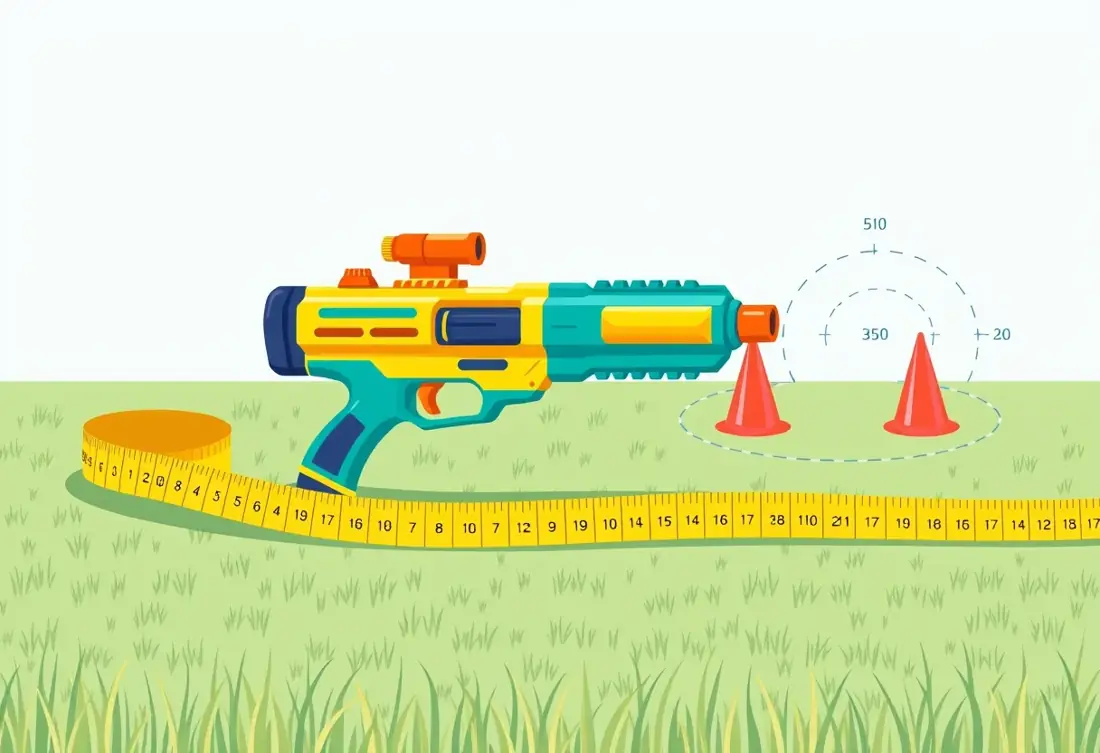
Toy blaster boxes and listings are full of numbers: feet per second, feet of range, rounds in the hopper, rounds per second. They look like facts. Most of them are claims, and they are often measured differently from blaster to blaster. This guide explains what each number means and how to use it.
FPS (feet per second)
FPS is how fast the ammo leaves the barrel. Higher FPS means more speed, and for a gel or foam blaster it also means a harder hit.
- It is almost always a maker’s claim, often phrased “up to”. The Gel Blaster Surge 2.0, for example, is listed by its maker at up to 175 fps, while some retailers list the same blaster lower.
- It depends on conditions. The ammo, the battery charge and the barrel setting all change the number. Some blasters have an adjustable setting, such as 90 to 170 fps.
- Foam makers often publish no FPS at all. Hasbro does not publish a velocity for the Elite 2.0 line, and we do not guess.
For safety, do not use FPS as a reason to go faster. Choose by the age rating on the box and keep play to the limits the maker sets.
Range
Range is how far the ammo travels. Makers usually print “up to” distances measured under ideal conditions.
- The Nerf Ultra Select is listed at up to 120 ft under Hasbro’s controlled testing, while the Elite 2.0 blasters list 90 ft.
- Water blasters list shorter ranges: the Super Soaker Hydro Frenzy at 30 ft, the SpyraThree at 35 ft, the SpyraGO at 26 ft.
- In a real yard, wind, angle and the ammo all cut the distance. Treat range as a ceiling, not a promise.
Where a maker does not publish a range, our pages say “not published”.
Hopper and magazine size
This is how many rounds a blaster holds before you reload.
- Gel hoppers run from 80 rounds (Nerf Pro Gelfire Twist Shot) to 1,200 (SplatRBall SRB1200).
- Foam drums are much smaller: 6 darts in the Commander RD-6, 15 in the Shockwave RD-15, 20 across two clips in the Ultra Select.
- Bigger is not always better. A big hopper means more weight and more to refill. Match it to the length of your game.
Rounds per second
Electric gel blasters often list a rate of fire, such as “up to 10 rounds per second”. That drains a 1,000-round hopper in minutes. It matters for how much ammo to carry: our ammo calculator turns players and minutes into rounds.
Battery life
Many listings say “rechargeable” and give no runtime. When the runtime is published, such as the SpyraThree’s battery rated for over 2,200 shots, we show it; when it is not, we leave it blank.
How to read a spec sheet
- Look for “up to”. It means a ceiling.
- Look for the source. A maker’s page beats a retailer listing, and a named review beats an anonymous one.
- Compare like with like. Foam, gel and water numbers do not compare directly.
- Check the age rating first. It decides who the blaster is for, whatever the other numbers say.
Every number on our product pages links to its source. See the spec table to sort and compare, and the gel blaster vs Nerf foam guide for how the families differ. Local rules vary; check yours before you buy or play.
Frequently asked questions
Why do two stores list different FPS for the same blaster? Makers update specs, retailers copy older figures, and some list the low end of an adjustable range. We link the source for each number.
Is more FPS better? Not for most players. A harder hit is not more fun, and the age rating matters more than speed.
Does a bigger hopper mean a better blaster? Not always. It means more rounds per fill, but also more weight and more to refill.
Why do some of your specs say “not published”? Because the maker did not publish the number, and we do not guess.