
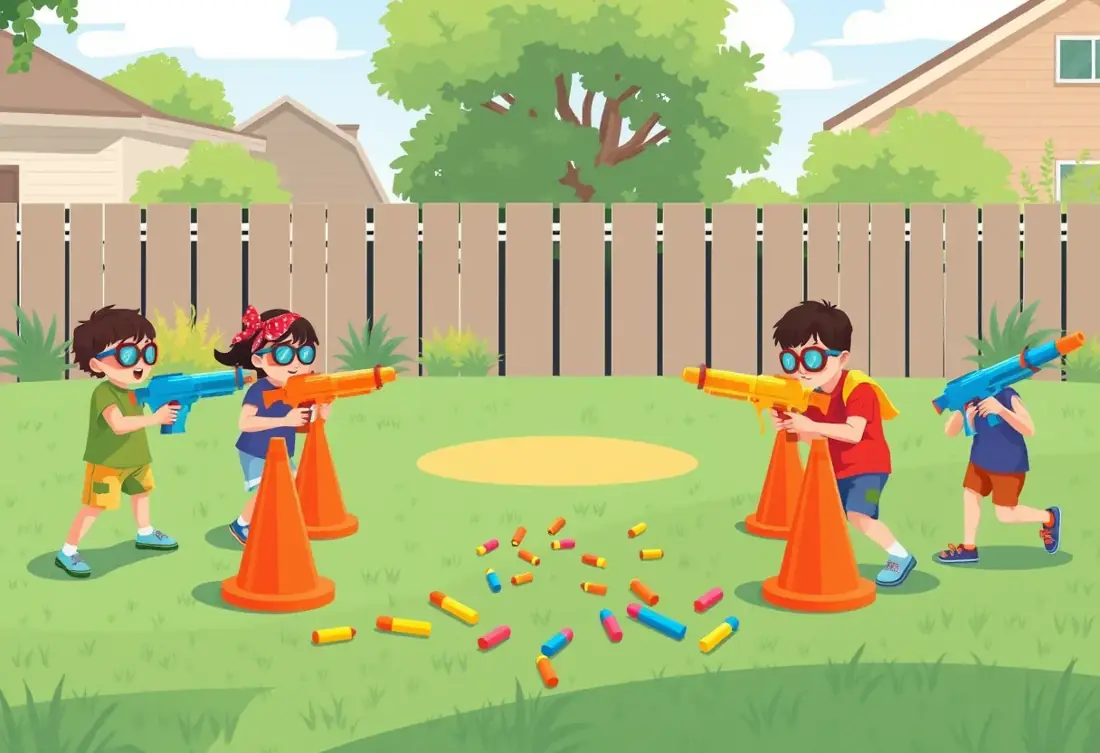
A Nerf war with 12 kids and no plan turns into chaos in about four minutes. A Nerf war with a quick setup and a few rules runs for an hour and everyone wants a rematch. Here is the planning framework that gets you to the second outcome.
This guide covers foam-dart blasters only. They are the right call for mixed ages (8+) and for anyone new to organized blaster games. If the group is teens 14 and older asking about gel blasters, start with the type comparison guide.
How many blasters do you need?
One blaster per player. Sharing slows the game down and kills momentum. The math is straightforward:
- 6 players: 3 blasters per team
- 10 players: 5 per team
- 16 players: 8 per team
The Commander RD-6 works well as a base blaster. No batteries, easy to prime, light enough for younger players. Add a Shockwave RD-15 per side for players who want more capacity without switching to a motorized setup. One Ultra Select per team gives experienced players a longer-range option, though it needs 6 C batteries (not included).
This page contains affiliate links. As an Amazon Associate, we earn from qualifying purchases.
All three blasters carry an 8+ age rating from Nerf.
| Blaster | Capacity | Range (claimed) | Power |
|---|---|---|---|
| Nerf Elite 2.0 Commander RD-6 | 6-dart rotating drum | up to 90 ft (Hasbro) | spring, no batteries |
| Nerf Elite 2.0 Shockwave RD-15 | 15-dart rotating drum | up to 90 ft (Hasbro) | pump-action slide, no batteries |
| Nerf Ultra Select | 20 darts (two 10-dart clips) | up to 120 ft (Hasbro controlled testing) | motorized flywheel, 6x C batteries |
Range figures are manufacturer claims under test conditions, not typical outdoor performance. The Commander and Shockwave include darts (12 and 30, respectively). The Ultra Select ships with two 10-dart clips but no batteries.
The downside of the Ultra Select is the battery situation. C batteries are not as common as AAs and not cheap. Check before you wrap it as a gift, not the morning of the party.
If you want a ready-to-buy matched kit for two teams of four, the two-team backyard war loadout has gel blasters for the older crowd and a spare foam blaster for younger players or a referee.
Setting up the play area
Mark the boundary before anyone picks up a blaster. Cones work well on grass. Chalk lines work on pavement.
Define three things before the first round:
The boundary is where the play area ends. Anyone who leaves it is out until the next round. Walk it with the group before you start.
Off-limits zones go inside the boundary. Garden beds, windows, the neighbor’s yard, any pets. Name them out loud.
Reload spots are fixed locations (one per team) where players can pick up spare darts without being targeted. Optional rule, but it solves the mid-game “I’m out of darts and I can’t move” problem.
Keep the play area out of sight lines where a passerby could see players with blasters and not have context for what is happening. A fence or hedge helps.
The backyard war rules guide has a ready-to-print rules sheet that covers these points and a few others.
Five game formats
Pick one format per session. Mixing formats in the same session creates arguments about which rules apply.
Two-team elimination
Each player has one life. Last team standing wins. Best as an opener while everyone learns the rules. Rounds are short (5-8 minutes), easy to reset.
Capture the flag
Each team guards a flag (a cone, a bandana, anything) at their base and tries to capture the other team’s flag. You have to carry the flag back to your base without getting hit. Works well for mixed ability groups because it creates distinct roles: attackers, defenders, and a dedicated runner.
Zombies vs survivors
One team starts as zombies, the other as survivors. When a zombie tags or hits a survivor, that survivor joins the zombies. Survivors win if any are still standing at the end of the time limit. Zombies win when all survivors are converted. Set a 10-minute timer; runs that go indefinitely usually end in stalemates.
VIP
Each team secretly picks a VIP player. Eliminate the other team’s VIP and your team wins, regardless of how many other players are left. Teams have to figure out who the VIP is and protect their own, which adds a strategic layer that pure elimination lacks.
Last one standing
Free-for-all with no teams. Works with 6 or fewer players. Above that it gets chaotic quickly and the last player standing usually wins by hiding, not skill. Good for when the group is tired of team formats.
Gear checklist
Before the first round:
- Eye protection for every player and any spectator inside the play area. Goggles that wrap the sides of the eyes, not sunglasses.
- Extra darts. Plan for roughly three times the total blaster capacity of both teams. Darts end up in flower beds, under chairs, and behind fences.
- A bag or bucket per team for mid-game and post-game dart pickup.
- Water and shade for outdoor summer sessions.
Say the no-headshots rule out loud before the first round. Do not print it on a sheet and hope everyone reads it.
A 60-minute schedule
This schedule works for 8-16 players:
- 0-10 min: distribute blasters, fit eye protection on every player, walk the boundary with the group.
- 10-15 min: read the rules out loud. Agree on a stop word everyone will use if there is a safety issue. No exceptions to calling stop.
- 15-30 min: game 1 (two-team elimination, two or three rounds so everyone gets the rules down).
- 30-40 min: dart pickup break. Count darts back into the bags, redistribute, swap team assignments.
- 40-55 min: game 2 (capture the flag or zombies, depending on what the group wants).
- 55-60 min: full dart sweep. Every dart goes into a bag.
The mid-session dart pickup matters. Running out of ammo mid-round stops the game faster than any rule dispute.
If you are using printable targets for a warmup game or skills stations before the main war, collect them at the end of this break.
Dart cleanup
Foam darts do not biodegrade. Any dart that goes over the fence, into the garden, or onto a roof stays there until someone retrieves it.
At the end of the session, split the yard into zones (one zone per two players works) and each person clears their zone. Check under chairs, inside planters, and along the fence line. It takes about five minutes and solves the “dart in the lawn mower” problem.
Frequently asked questions
How many darts do I need for a Nerf war?
Budget for roughly three times the total blaster capacity of both teams. For a 10-player game with five Commander RD-6s (6-dart drums) and five Shockwave RD-15s (15-dart drums), that is around 300 darts as a working cushion. You will lose some in bushes and behind things no matter what.
What age is right for a Nerf war?
The blasters on this page are rated 8+ by Nerf. Mixed groups spanning a wide age range do fine with foam. If anyone in the group is under 8, treat the youngest player as the limit and stick with the lightest, lowest-range options. See the type comparison guide for a full age-by-age breakdown.
Does the Nerf Ultra Select need batteries?
Yes. Six C batteries, and they are not included. It is the only motorized option on this page; the Commander and Shockwave both run on spring or pump-action priming with no batteries at all.
Can players use third-party darts in Elite 2.0 blasters?
Many third-party Elite-compatible darts work, but feed reliability varies by blaster and dart brand. The Ultra Select is different: it uses a separate Ultra dart format that is not compatible with standard Elite darts. The two clips it ships with are for Ultra darts only.
Build the play area with the backyard blaster fort guide, and teach your team how to defend yourself in a blaster war and make DIY shields.